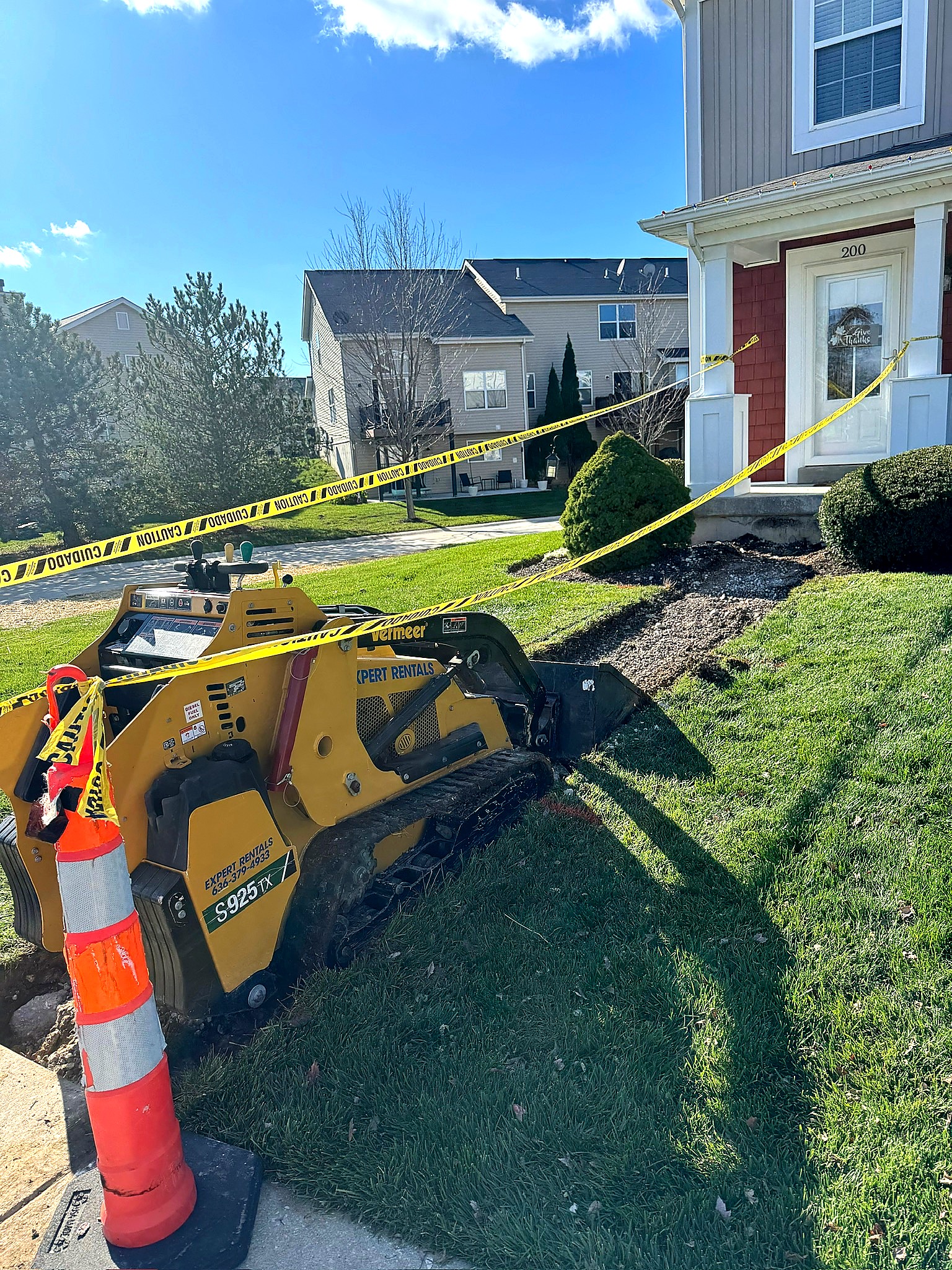
Every concrete failure that isn't caused by a bad mix is caused by what's underneath the slab. Grading and site prep aren't an upgrade — they're the foundation of every project we pour. We do this work in-house on every job and as a standalone service for builders, landscapers, and property owners.
You can pour a 5,000 PSI mix on top of uncompacted dirt and your slab will still fail within five years. Conversely, you can pour a standard 4,000 PSI mix on a properly graded, compacted, drained sub-base and it'll outlast the homeowner. The concrete gets the credit when things work and the blame when they don't, but in reality the work that determines a slab's life is happening underneath, before the mixer truck even arrives.
We walk the site, identify existing drainage patterns, check for buried utilities (calling Missouri One Call for locates), and lay out the project to the dimensions in the contract. Any conflict between the design and reality — a low spot that ponds water, an old footing, a utility lateral that needs to be worked around — gets addressed before we start digging.
Soil removed to the depth required for the slab thickness plus the sub-base depth. A typical 4" patio with 4" of compacted aggregate base needs roughly 8" of total excavation. Excavated soil is either hauled off-site or used elsewhere on the property (regrading low areas, filling planting beds).
Every flatwork pour needs to drain. Patios and driveways are typically sloped 1/8" to 1/4" per foot away from the house — enough to move water without being noticeable. We assess where the water will go after it leaves your concrete: into a swale, toward a drain, away from your foundation. Bad drainage is the slowest, most expensive failure mode in concrete; it shows up years later as undermined edges and settled corners.
4" of compacted aggregate base (typically Class 5 or 1" minus crushed stone) under every flatwork pour. The aggregate is installed in lifts (2" at a time) and compacted with a plate compactor or jumping jack between lifts. The compacted base is the surface the concrete bonds to and the load-distribution layer that prevents settlement.
Edge forms (typically 2×4 or 2×6 lumber, sometimes flexible composite for curves) set to grade with stakes every 2–3 feet. The forms define the slab dimensions and hold the concrete at the right elevation while it cures.
Fiber reinforcement is added to the concrete mix itself (no placement step). Rebar mats — required on apron sections, heavy-duty pads, and large slabs — are installed on chairs to position the steel at the correct depth inside the slab (typically center-of-slab for residential work).
We provide grading and site prep as a standalone service for:
Grading is included as part of every concrete project we pour — no separate site-prep line item. Standalone grading work is priced after an on-site walkthrough. Request your free estimate.
Site work across St. Charles, O'Fallon, St. Peters, Wentzville, Lake St. Louis, Cottleville, Dardenne Prairie, Weldon Spring, and Defiance.
No. Grading and site prep are included on every concrete project we install. The only reason to hire a separate grading contractor is if you're doing prep work for something other than concrete — paver work, a foundation, drainage corrections.
For a standard 4″ slab with 4″ of compacted base, we excavate about 8″ total. Driveways with 5–6″ slabs need 9–10″ of excavation. Excavated soil is hauled off-site or used to fill low areas on the property as appropriate.
Yes — that's actually one of the best times to fix them. We evaluate drainage during the estimate and incorporate slope corrections, French drains, or surface drains into the install. Adding drainage after the concrete is poured is significantly more expensive.
Yes. We provide grading, excavation, and site prep as a standalone service for builders, landscapers, and homeowners — pad prep for sheds and hot tubs, drainage corrections, paver base prep, foundation prep. Quoted per project.